
Ant control across Gauteng
A trail across the kitchen counter every morning, ants in the sugar and the pet food, little cones of sand between the paving. You spray the trail and a new one appears the next day, because the trail is one branch of a colony with several nests and often several queens. Ecopoise treats the nests, inside and out, with a written 3 months guarantee.
Why spraying the trail never lasts
A forager that finds food lays a scent trail home, and the others follow it and strengthen it. Kill the ants on the trail and the nest, which you have not touched, sends more. Many of the ants in Gauteng homes keep several queens in one nest and spread by budding: a queen simply walks off with a group of workers to start another nest nearby. The Argentine ant links its nests into one supercolony. The Pharaoh ant scatters into new nests when its nest is disturbed, so a shop spray can multiply the problem. Their queens are short-lived and constantly replaced: Argentine ant workers kill about nine in ten of their queens every spring and rear new ones, and a Pharaoh ant queen lives four to twelve months.
Which ant is it?
- Argentine ant. Two to three millimetres, a uniform brown, smooth and hairless, in long trails of thousands. Nests shallowly under stones, in leaf litter and in cracks in concrete; when the nest floods, the workers carry the brood to dry ground, which is why they appear indoors after heavy rain. Prefers sweet food. An invader from South America, in the country since the early 1900s and present in most provinces, Gauteng among them.
- Brown house ant (African big-headed ant). Small workers about two millimetres, with a few larger ones whose heads are out of all proportion. Nests underground, often under paving, with a cone of sand grains at the entrance. A native species, and one of the worst invaders elsewhere in the world. It chews irrigation lines and electrical cabling.
- Small black ant. Just over two millimetres, black, running in trails; nests in the ground, in walls or under floors.
- Pugnacious ant. Big for a household ant, in several sizes from about four to ten millimetres, yellowish to chocolate brown, aggressive, in dry open ground and under paving.
- Sugar ants. The large Camponotus ants, eight millimetres and more: the spotted sugar ant that comes out at night without trails, and the hairy balbyter by day. A nuisance indoors rather than a danger.
- Pharaoh ant. Two millimetres, yellow to light brown, darker at the tail. Nests in wall and cupboard voids and near hot pipes, with many queens. A problem in hospitals, hotels and kitchens.
-
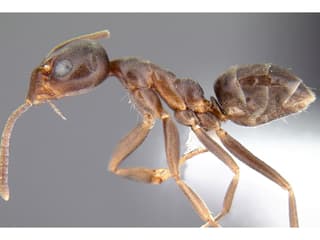 Argentine antLinepithema humile2 to 3 mm, a uniform brown, hairless, in long trails.
-
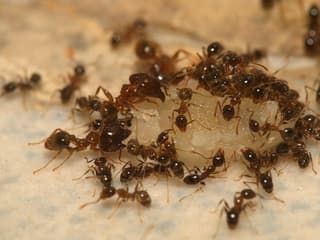 Brown house antPheidole megacephalaWorkers about 2 mm, with a few larger 3 to 4 mm workers whose heads are out of all proportion.
-
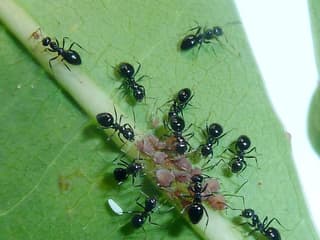 Small black antLepisiota capensisJust over 2 mm, black with paler legs, running in trails; here tending aphids on a leaf in Pretoria.
-
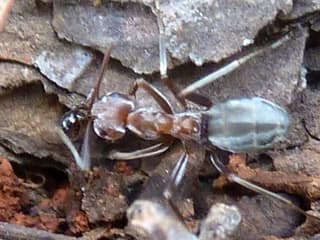 Pugnacious antAnoplolepis custodiens4 to 10 mm in several sizes, yellowish-brown to chocolate, aggressive; dry open ground and under paving.
-
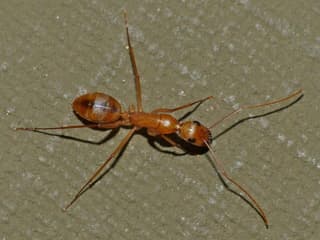 Spotted sugar antCamponotus maculatusBig, 8 mm and more, pale to reddish brown with two to four patches of a different colour on the rear; out at night, no trails.
-
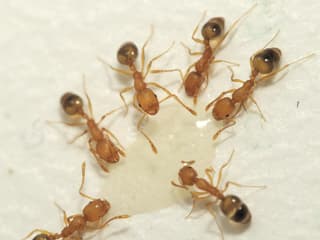 Pharaoh antMonomorium pharaonisAbout 2 mm, yellow to light brown, darker at the tail; wall and cupboard voids, warm pipes.
The photos are a guide, not a diagnosis. Species vary, and a technician on site will confirm which one you have.
Why they come inside
Ants enter a building for food and water, for warmth, or for refuge from hot dry weather or from flooding, and they can appear suddenly when the weather changes or outdoor food runs out. In Gauteng that means the first good summer rains, and the dry winter, when a watered garden and a warm house are the only moisture around.
Flying ants or termites?
Ants have elbowed antennae, a pinched waist and back wings smaller than the front pair. Termites have straight, bead-like antennae, no waist and four equal wings. Termites of both sexes and mated ant queens shed their wings after the flight; male ants keep theirs and soon die. If you are not sure, see the termites page or send us a photo.
Do they do harm?
Most ants in a home are a nuisance rather than a health risk, though hospital studies have found ants carrying bacteria, and no one wants them in a kitchen or a food plant. In the garden they do real damage by farming aphids, scale and mealybugs for their honeydew and guarding them from ladybirds, so an ant trail up a tree usually means aphids, scale or mealybugs above (sometimes only nectar or ripe fruit). The brown house ant chews irrigation lines and cables.
What Ecopoise does
- Registered operators. Registered pest control operators with the Department of Agriculture; certified members of SAPCA and PCFSA.
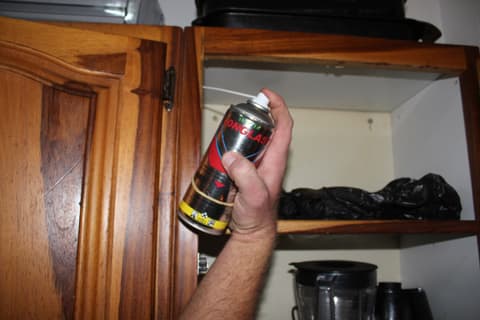
- Inside and outside. The technicians spray a perimeter barrier inside and outside the building, with spot treatments where they find activity. The barrier protects the house for the guarantee period.
- The nests, not just the trail. A gel-bait and granular-bait treatment is included, which the foragers carry back to destroy the nests directly.
- During the visit, anyone elderly, any infant and anyone with asthma must be away from the premises, and stay away for four hours after the treatment is done. Birds and fish go outside before we start.
- Guarantee: 3 months, in writing.
- Price. There are no set prices, because the price depends on the size of the area to be treated. Every job is quoted first.
Questions people ask
Do I need to leave the house?
Only the elderly, infants and people with asthma, who must be away during the treatment and for four hours after it. Pet birds and fish go outside first.
Why does my garden get them every year?
Ants come in with the first good summer rains and again in the dry winter, when the garden tap and the warm house are the only water around. The barrier lasts the guarantee period indoors; outside, rain and sun break it down, so a yearly treatment keeps ahead of them.
Can I just send you a photo?
Yes. Send us a clear photo on WhatsApp. Nine times out of ten we can tell you what it is; when we cannot, we send it to an entomologist. WhatsApp it to 078 900 1536.
Sources and photo credits
Sources: University of California IPM Pest Notes 7411 (ants, 2012) and 7416 (carpenter ants, 2009); the IUCN Global Invasive Species Database on the Argentine ant and the big-headed ant; Mothapo and Wossler, BMC Ecology 2011 and Ecological Entomology 2014; Stellenbosch Centre for Invasion Biology (2014); Peter Slingsby, Ants of the Cape; SANBI on the balbyter (2015); Fowler and others 1993 and Beatson 1972 on ants in hospitals; Wikipedia, "Ant", "Argentine ant", "Pheidole megacephala", "Pharaoh ant" and others (read 30 Oct 2026); Gauteng pest firms for the seasonal timing; Ecopoise's own treatment information letter for the treatment. Ecopoise keeps the full fact bank with every reference.
Identification photos, via Wikimedia Commons, cropped and resized: Argentine ant: Alex Wild, AntWeb.org (CC BY 4.0); Brown house ant: Sarefo (CC BY-SA 3.0); Small black ant: JMK (CC BY-SA 3.0); Pugnacious ant: JMK (CC BY-SA 3.0); Spotted sugar ant: Bernard Dupont (CC BY-SA 2.0); Pharaoh ant: Землеройкин (CC BY-SA 4.0). The licence names link to the full licence text.


Seen the signs? Call or WhatsApp 078 900 1536
All of Gauteng.