
Termite control across Gauteng
A cloud of flying termites after the first summer rain, mud tubes running up a wall, a skirting that sounds hollow when you tap it: by the time you see termites, they have usually been eating for a while. Ecopoise's registered operators treat subterranean termites with a drilled-and-injected chemical barrier around the whole building, with a written guarantee and a certificate of completion.
Termite or flying ant?
The swarmers look alike, so check three things. Termite antennae are straight and bead-like; an ant's are elbowed. A termite has no pinched waist; an ant does. A termite's front and back wings are the same length; an ant's front wings are longer. Both shed their wings after the flight, so you may find only wings on a windowsill.
-
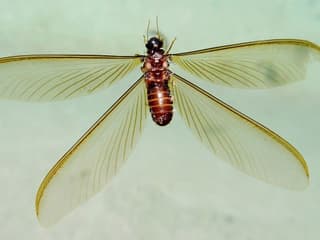 Flying termiteHodotermes mossambicusFour wings of equal length, straight bead-like antennae, no waist. This one was photographed on water in Gauteng.
-
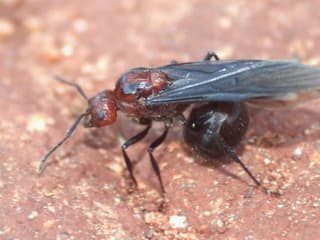 Flying ant, for comparisonMyrmicaria natalensisElbowed antennae, a pinched waist, and front wings longer than the back pair.
The photos are a guide, not a diagnosis. Species vary, and a technician on site will confirm which one you have.
Which termite is it?
- Subterranean termites live underground and build mud tubes from the soil to the timber they feed on. They stay hidden until the damage is advanced. The tubes protect the workers from ants and from drying out; they can be as thin as a pencil or several centimetres wide, and can run a long way. In Gauteng the fungus-growing termites, chiefly Macrotermes natalensis and Odontotermes species, build the big mounds and clay chimneys you see on the veld. They are also the subterranean termites that attack buildings here: a 2009 review, drawing on Mitchell's 2002 survey of southern Africa, attributes over 90 percent of termite damage to farming, forestry and buildings to this group. The Coptotermes termites of Asia, Australia and the Americas do not occur here.
- Drywood termites live entirely inside the timber they eat, in furniture, roof beams and flooring, and need no soil or water. They hollow the wood from the inside and leave a thin shell; their giveaway is dry, seed-like droppings, called frass, falling from tiny holes. In South Africa they are mainly a coastal problem; we know of no published Gauteng record, though infested furniture can be carried anywhere.
- Harvester termites eat grass, not timber, and are the ones stripping lawns. They have their own page.
-
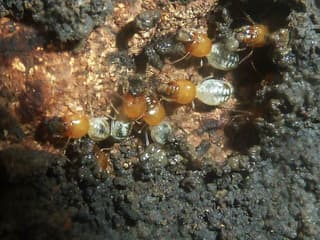 Subterranean termites (fungus-growing group)Odontotermes badiusNests underground with clay chimneys; its relative Macrotermes builds the big veld mounds. The main timber termites of Gauteng houses, as well as a crop and forestry pest.
-
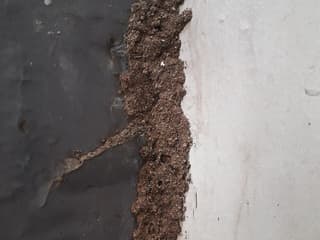 Mud tubeSoil tubes from the ground up walls, foundations and timber, keeping the workers damp and hidden.
-
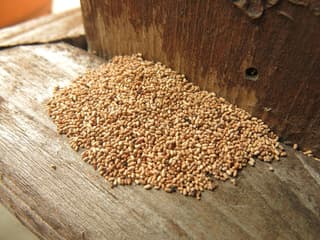 Termite frassDrywood termites push dry, seed-like pellets out of the timber; a pile like this under a tiny hole is the giveaway.
-
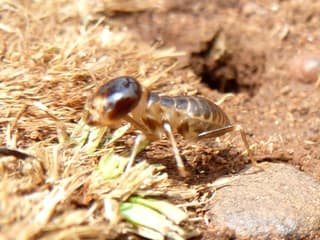 Harvester termitesHodotermes mossambicusWorkers with a dark brown head, a body striped brown and cream and working eyes, out in the open cutting grass; the lawn stripper, not a timber pest.
The photos are a guide, not a diagnosis. Species vary, and a technician on site will confirm which one you have.
Signs you have termites
- Flying termites indoors or around lights after rain, and shed wings on windowsills.
- Mud tubes on foundations, walls or the back of skirtings.
- Timber that sounds hollow, blistering or rippling paint. Doors and windows that stick are more often damp than termites.
- Small, hard, dry pellets like coarse sand or coffee grounds, not soft sawdust, under furniture or roof timbers (drywood termites).
- Damage often goes unnoticed until only a thin outer layer of wood remains.
Why it matters
Of roughly 3,000 living termite species, fewer than 200 are known to damage buildings and about 80 do serious damage. A mature mound-building colony holds hundreds of thousands of termites; the biggest termite colonies in the world run into the millions. A mature queen of the mound-builders lays thousands of eggs a day and can live for twenty years or more. Only the workers feed, and in the warm months they feed around the clock; activity slows in the cold dry season.
When they swarm in Gauteng
Swarms follow rain in the warm months, late spring and summer, when the air is humid. Macrotermes natalensis, the big mound-builder, flies from late September to early December around Pretoria, peaking in October, at dusk after at least 5 mm of rain. The winged termites gather around lights, land, shed their wings and pair up to start new colonies. Harvester termites fly in the late afternoon and early evening, a few days after good summer rain.
What Ecopoise does
- Registered operators. Registered pest control operators with the Department of Agriculture; certified members of SAPCA and PCFSA.
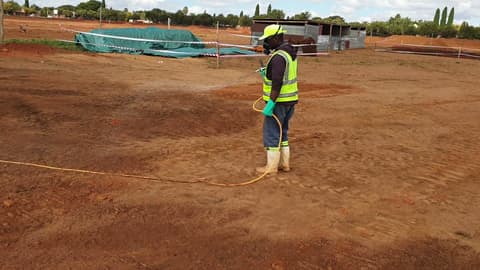
- Subterranean termites: a drilled-and-injected barrier. Holes are drilled into the foundation at close intervals around the entire building and a termiticide barrier is injected into each one; where drilling is impossible, a trench is dug instead. The barrier stays active for five years, and the treatment comes with a five-year guarantee and a certificate of completion.
- Soil pre-treatment for new buildings. The same barrier, laid into the soil of a building site before construction, so the finished building starts protected.
- Price. There are no set prices, because the price depends on the size of the area to be treated. Every job is quoted first.
Questions people ask
Are these flying ants or termites?
Look at the waist and the wings. No pinched waist and two pairs of equal wings means termite. A narrow waist and longer front wings means ant. Either way, a swarm indoors is worth a call.
Do you have to drill through my floors?
The holes go into the foundation around the outside of the building, at close intervals, and are sealed afterwards. Where drilling is impossible, a trench is dug instead.
How long does the barrier last?
The termiticide stays active for five years, which is why the treatment carries a five-year guarantee and a certificate of completion.
Can you treat a building site before we build?
Yes. A soil pre-treatment lays the barrier into the ground before construction. Ask for it when the slab is being planned.
Can I just send you a photo?
Yes. Send us a clear photo on WhatsApp. Nine times out of ten we can tell you what it is; when we cannot, we send it to an entomologist. WhatsApp it to 078 900 1536.
Sources and photo credits
Sources: Wikipedia, "Termite", "Hodotermes" and "Cryptotermes brevis" (read 27 Oct 2026); University of Florida IFAS, Featured Creatures (EDIS IN278); Mississippi State University Extension, "Are these termites or ants?"; Rhodes University, dry wood termites of South Africa; J.D. Mitchell, "Termites as pests of crops, forestry, rangeland and structures in southern Africa and their control", Sociobiology 40 (2002): 47 to 69, as reported by Sileshi and others 2009, Ecology and Society 14(1): 48; Mitchell 2008, African Entomology 16(2), on the swarming flights of Macrotermes natalensis; Johannesburg pest firms (EcoSmart Pest, Pest Control Experts) for the signs list; Ecopoise's own treatment information letter for the treatment. Ecopoise keeps the full fact bank with every reference.
Identification photos, via Wikimedia Commons, cropped and resized: Flying termite: JMK (CC BY-SA 3.0); Flying ant, for comparison: JMK (CC BY-SA 4.0); Subterranean termites (fungus-growing group): JMK (CC BY-SA 4.0); Mud tube: Saipul bakrie (CC BY-SA 4.0); Termite frass: Sanjay Acharya (CC BY-SA 3.0); Harvester termites: JMK (CC BY-SA 3.0). The licence names link to the full licence text.


Seen the signs? Call or WhatsApp 078 900 1536
All of Gauteng.