
Rat and mouse control across Gauteng
Scratching in the ceiling at night, droppings behind the kettle, a cable chewed through in the garage. Rats and mice move indoors when the Highveld nights turn cold, and a pair becomes a colony within months. Ecopoise treats homes and businesses with locked, tamper-proof bait stations, a service report for your records, and a written 1 year guarantee.
Which one do you have?
- Brown rat (Norway rat). Stocky, blunt muzzle, small ears, a tail shorter than its body. Around 200 to 500 grams. Burrows along foundations, under rubbish and woodpiles; indoors it keeps mostly to ground floors. The strong swimmer, and it needs to drink every day.
- Roof rat (black rat). Slimmer, pointed muzzle, big ears, a tail longer than head and body together. Around 140 to 280 grams. Lives above ground in trees, creepers, roof spaces and ceiling voids, runs along fence tops and power lines at dusk, and often gets into a building from the roof.
- Asian house rat. A third rat found at urban sites across Gauteng. It looks like the roof rat and only DNA tells them apart; it lives in ceilings, roofs and wall gaps in the same way.
- House mouse. About 12 to 25 grams, light brown to grey, a nearly hairless tail. Nests in shredded paper near a heat source and seldom travels more than nine metres from food.
A quick tell is the droppings. Mouse droppings are 3 to 6 millimetres long; roof rat droppings about 13 millimetres; brown rat droppings 19 to 25 millimetres.
-
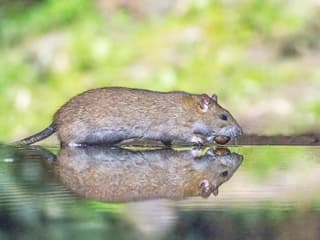 Brown rat (Norway rat)Rattus norvegicusStocky, blunt muzzle, small ears, a tail shorter than its body; around 200 to 500 g. Burrows at ground level.
-
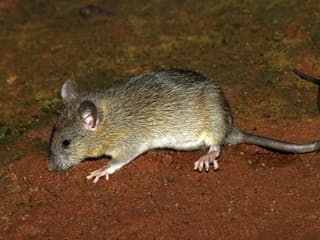 Roof rat (black rat)Rattus rattusSlimmer, pointed muzzle, big ears, a tail longer than head and body; around 140 to 280 g. Climbs into roofs. The Asian house rat looks the same.
-
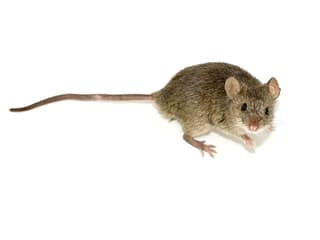 House mouseMus musculus12 to 18 cm including the tail, 12 to 25 g, light brown to grey with a nearly hairless tail.
The photos are a guide, not a diagnosis. Species vary, and a technician on site will confirm which one you have.
Signs
- Droppings near pet food, in drawers, along skirtings and behind appliances.
- Gnaw marks on fruit, packaging, cables and timber: rat tooth marks are about 4 millimetres wide, a mouse's about 2.
- Noises in the ceiling or walls at night: gnawing, running, squeaks.
- Greasy smudge marks from fur on beams, pipes and walls along their runs.
- Burrows under compost, bins or paving; nests in firewood or garage drawers.
- A musky smell in a long-running mouse problem.
Why it gets out of hand
A brown rat has four to six litters a year of six to twelve young, and the young breed at three months; in theory as many as sixty to seventy offspring from one female can mature in a year, though in practice she weans twenty or more. A house mouse has five to ten litters a year and breeds at five to six weeks. Mice squeeze under a gap six millimetres high; young rats pass under a door with a thirteen-millimetre gap. And rodents must gnaw: their front teeth never stop growing, well over ten centimetres a year for a rat, so they chew cables, pipes, insulation and car wiring, which is one way roof-space fires and gas leaks start.
Health risks
- Leptospirosis spreads through the urine of infected rats and mice, by contaminated water, soil or food, especially after heavy rain. Most cases are mild; about one in ten is severe. In 2015 it killed an inmate at a Cape Town prison, and two thirds of the brown rats trapped there carried it.
- Rat-bite fever passes through bites, scratches or a rodent's saliva and urine. In a Gauteng study, half the urban rats swabbed carried the bacterium.
- Rats and mice also carry salmonella and other stomach bugs, and mouse urine is a major allergen linked to asthma in children.
Food businesses
Regulation R638 under the Foodstuffs, Cosmetics and Disinfectants Act applies to every place that handles, prepares, transports or sells food, and municipal environmental health practitioners enforce it. The regulation makes the person in charge responsible for effective measures to prevent or eliminate rodents and other pests, and for keeping appropriate records. Inspectors look for both, and for any sign of pests. Every Ecopoise visit comes with a service report for your records. See pest control for your business.
What Ecopoise does
- Registered operators. Registered pest control operators with the Department of Agriculture; certified members of SAPCA and PCFSA.
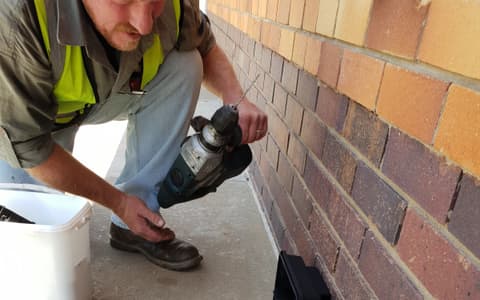
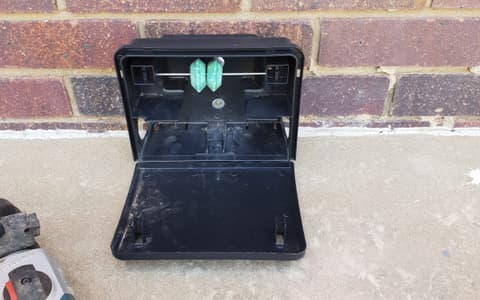
- Locked bait stations. Tamper-proof, drill-mounted boxes are installed around the property. They are locked, and only our technicians have the key. The stations remain the property of Ecopoise.
- A multi-feed bait. The rodents feed over several days and die off in 4 to 14 days. The product has a delayed effect, so the rodents keep feeding on it; as a multi-feed bait it carries a lower risk of secondary poisoning, where a pet or an owl eats a poisoned rodent, than single-feed baits. It is endorsed by the Griffin Poison Information Centre.
- If a pet is suspected of secondary poisoning, see a vet at once: the antidote is vitamin K1, which the vet gives for several weeks, usually tablets after a first injection.
- Guarantee: 1 year, in writing.
- Price. There are no set prices, because the price depends on the size of the area to be treated. Every job is quoted first.
Questions people ask
Is the bait safe for my dog or cat?
The stations are locked and tamper-proof, so pets cannot reach the bait. The product has a delayed effect, so the rodents keep feeding on it; as a multi-feed bait it carries a lower risk of secondary poisoning, where a pet or an owl eats a poisoned rodent, than single-feed baits. If you ever suspect a pet has eaten a poisoned rodent, see a vet at once; the antidote is vitamin K1, which the vet gives for several weeks, usually tablets after a first injection.
Will the rats die in my ceiling and smell?
Rodents poisoned at the outdoor stations can still die where they nest, so there is a chance of one dying in a roof or wall void, more likely in a heavy infestation.
Why do they come inside in winter?
Johannesburg's winter nights drop to around four degrees with frost, and natural food runs short in the dry months. Mice are most likely to invade buildings as temperatures fall, and rats, too, move into roof spaces, wall voids and geyser cupboards for shelter.
Do I keep the bait stations?
No. The stations remain Ecopoise's property, and every visit comes with a service report for your records.
Can I just send you a photo?
Yes. Send us a clear photo on WhatsApp. Nine times out of ten we can tell you what it is; when we cannot, we send it to an entomologist. WhatsApp it to 078 900 1536.
Sources and photo credits
Sources: University of California IPM Pest Notes 74106 (rats, updated June 2025) and 7483 (house mouse, updated July 2025); ICWDM species pages; Cornell IPM; Mississippi State University Extension P2824; Julius and others, Yale Journal of Biology and Medicine 2021 (the three Gauteng rats and rat-bite fever); SANBI on the Asian house rat (2024); CDC on leptospirosis (2026) and rat-bite fever (2024); NICD on leptospirosis; Naidoo and others, Emerging Infectious Diseases 2020 (the Cape Town prison case); Government Notice R638 of 22 June 2018; Wikipedia, "Brown rat", "Rodent" and "Johannesburg" (read 30 Oct 2026); Ecopoise's own treatment information letter for the treatment. Ecopoise keeps the full fact bank with every reference.
Identification photos, via Wikimedia Commons, cropped and resized: Brown rat (Norway rat): Charles J. Sharp (CC BY-SA 4.0); Roof rat (black rat): David V. Raju (CC0); House mouse: George Shuklin (CC BY-SA 1.0). The licence names link to the full licence text.


Seen the signs? Call or WhatsApp 078 900 1536
All of Gauteng.