
Harvester termite control across Gauteng
Thinning, bare patches spreading across the lawn, the grass cut off short, and termites out in the open in broad daylight carrying bits of grass: those are harvester termites, the lawn termites Afrikaans calls rysmiere. They do not attack the timber in a house, but they will strip a lawn or a paddock. Ecopoise treats them over three visits, with a written 3 months guarantee.
What harvester termites are
The African harvester termite, Hodotermes mossambicus, also called the northern harvester termite (grasdraertermiet in Afrikaans), lives on grass: one study found grass to be about 93 percent of its diet. The workers are 8 to 13 millimetres long, with a dark brown head and a body striped brown and cream. The soldiers are bigger, about 15 millimetres, with strong, toothed jaws. Unlike the termites that eat timber, the workers have colour and working eyes, which is why you see them out in the open: grazing in bright sunlight, especially in autumn and early winter, and mostly at night once the summer rains start. The nest is not one mound but several spherical hives up to 60 centimetres across, spread underground from just below the surface to more than six metres deep, joined by tunnels.
Signs
- Patches of lawn or pasture stripped bare, spreading outward from the holes.
- Termites visible on the surface, often carrying cut pieces of grass, with small holes where they come and go.
- Small heaps of loose soil on the lawn, like little mole-hills, where they have been digging.
- Winged termites on warm afternoons and early evenings a few days after the first good summer rains; after the flight each pair digs a burrow to start a colony.
-
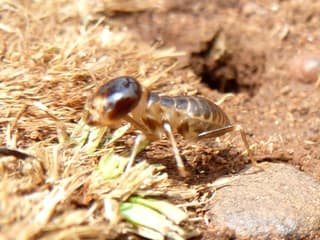 A harvester termite workerHodotermes mossambicusA dark brown head and a body striped brown and cream, 8 to 13 millimetres long, beside the hole it works from. Photographed at Schanskop, Pretoria.
-
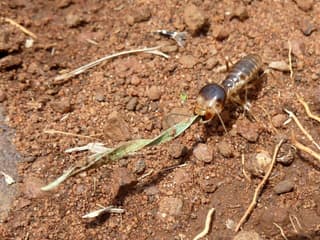 Carrying grass homeWorkers cut grass and carry the pieces to holes in the ground, in the open and in full sun. This one is taking a blade to the nest.
-
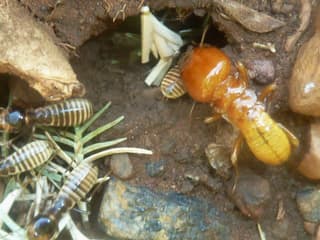 A soldier with the workersSoldiers are bigger, about 15 millimetres, with a large orange head and strong jaws. This one is at a hole where workers are carrying dry grass in, in Arcadia, Pretoria.
-
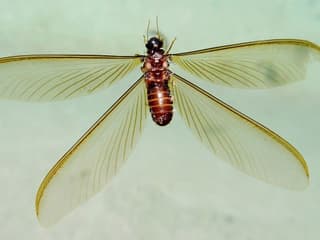 The flying stageWinged harvester termites fly on warm afternoons and early evenings, a few days after good summer rain.
The photos are a guide, not a diagnosis. Species vary, and a technician on site will confirm which one you have.
Harvester termites or house termites?
Harvester termites eat grass and nest deep under the ground, often well beyond the lawn they are stripping. Subterranean termites eat timber and live under and inside buildings; they build mud tubes up walls. The treatments are different, so it matters which one you have. If in doubt, see the termites page or send us a photo.
What Ecopoise does
- Registered operators. Registered pest control operators with the Department of Agriculture; certified members of SAPCA and PCFSA.
- Three visits over three weeks. The technicians look for the exit points of the tunnels and spray the visible cavities and tunnels in the lawn. The colonies and their tunnels are complex and out of sight, so three treatments over three weeks give the strategy time to work: the more tunnels found, the better the result.
- Guarantee: 3 months, in writing.
- Price. There are no set prices, because the price depends on the size of the area to be treated. Every job is quoted first.
Questions people ask
Why three visits?
Because the nests are spread out underground and most of the tunnel system cannot be seen from the surface. Each visit finds more exit points, so three treatments over three weeks reach far more of the colony than one.
Are these the termites that will eat my house?
No. Harvester termites eat grass. The ones that eat timber are subterranean and drywood termites, and they have their own page.
Can I just send you a photo?
Yes. Send us a clear photo on WhatsApp. Nine times out of ten we can tell you what it is; when we cannot, we send it to an entomologist. WhatsApp it to 078 900 1536.
Sources and photo credits
Sources: South African National Biodiversity Institute (SANBI), "African harvester termite", 2023 (names, sizes, colouring, grazing in sunlight; read 17 Nov 2026); Wikipedia, "Hodotermes", citing Scholtz and others 1985, Picker and others 2004, Nel 1968, Coaton 1958, Nel and Hewitt 1978 and Bell 1999 (read 27 Oct 2026); Symes and Woodborne 2011 (the 93 percent); Leuthold and Bruinsma 1977 and Hewitt and Nel 1969 (flight timing); Fuller, "The termites of South Africa", South African Journal of Natural History 1921 (the heaps of loose earth), together with Ecopoise's own job footage of 29 Oct 2026; the Wikimedia Commons photo descriptions by JMK; Ecopoise's own treatment information letter for the treatment. Ecopoise keeps the full fact bank with every reference.
Identification photos, via Wikimedia Commons, cropped and resized: A harvester termite worker: JMK (CC BY-SA 3.0); Carrying grass home: JMK (CC BY-SA 3.0); A soldier with the workers: JMK (CC BY-SA 4.0); The flying stage: JMK (CC BY-SA 3.0). The licence names link to the full licence text.


Seen the signs? Call or WhatsApp 078 900 1536
All of Gauteng.