
Bed bug treatment across Gauteng
Itchy bites in a line when you wake, rusty dots on the sheets, tiny dark specks in the mattress seam. Bed bugs have nothing to do with a dirty house: they arrive in luggage, second-hand furniture or from the room next door, and they hide in cracks the width of a credit card. Ecopoise treats the room, the seams of mattresses and couches and the spots the technicians find, with a written 3 months guarantee.
What they look like
An adult bed bug is the size and shape of an apple seed, five to seven millimetres, flat and rusty brown when hungry, longer and balloon-like after a blood meal. The five nymph stages run from one and a half to four and a half millimetres; unfed, they are translucent and easy to miss. The eggs are a millimetre long, pearl-white and glued to rough surfaces. All of them can be seen with the naked eye, if you know where to look. Two species occur in South Africa, the common bed bug and the tropical bed bug.
-
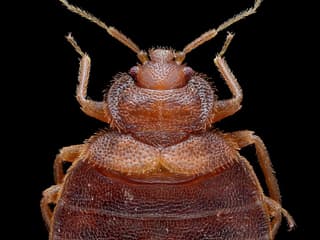 Bed bugCimex lectulariusThe size and shape of an apple seed, 5 to 7 mm, flat and rusty brown when hungry.
-
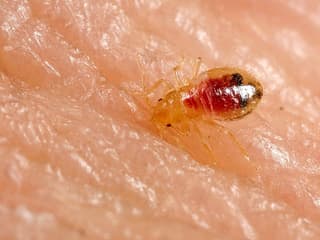 A nymphNymphs are 1.5 to 4.5 mm and translucent when unfed; this one is feeding. The eggs are 1 mm, pearl-white, glued to rough surfaces.
-
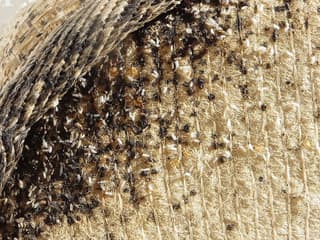 The seamDark dots that bleed into the fabric, with eggs and eggshells, along mattress piping and seams.
The photos are a guide, not a diagnosis. Species vary, and a technician on site will confirm which one you have.
Where they hide
Most of a room's bed bugs, by the usual estimate about 85 percent, are in or near the bed: mattress piping, seams and tags; cracks in the bed frame and headboard. The rest are in couch seams and between cushions, curtain folds, drawer joints, behind loose wallpaper and wall hangings, in electrical sockets, even in the head of a screw. They stay within about two metres of where people sleep, but can travel thirty metres in a night, which is how they cross into the next room.
Signs
- Bites that appear one to several days after you were bitten, sometimes up to fourteen, often in a line or cluster on the face, neck, arms or hands. They look like mosquito or flea bites, and some people get no mark at all.
- Rusty or reddish stains on sheets and mattresses from crushed bugs.
- Dark dots the size of a full stop that bleed into fabric like a marker: droppings.
- Pale yellow shed skins and one-millimetre eggshells in the seams.
- A sweet, musty smell in a heavy infestation.
How they got in
They ride in the seams and folds of luggage, overnight bags, folded clothes, bedding and furniture, and most carriers never know. Hotels, lodges, hostels, buses and trains spread them; second-hand mattresses and couches bring them home; an infested flat passes them to the one next door. They are not attracted to dirt. They are attracted to warmth, blood and carbon dioxide, and leaving a light on does not keep them off.
Do they spread disease?
No. Bed bugs are not known to spread any disease to people. The harm is the bites, the itch, the scratching that gets infected, and the sleep you lose. Their bite numbs the skin, so you never feel it; adults feed every three to seven days, for three to ten minutes at a time, mostly at night.
Why they are back
Bed bugs were nearly wiped out in the developed world in the mid-twentieth century (they never left rural Africa) and have surged again worldwide since the 1990s. The main reason, the research says, is resistance to the common insecticides, with travel and second-hand goods behind it too. That is one reason a can of spray from the shop so often disappoints. A common bed bug female lays a few eggs a day and a couple of hundred in her life (the tropical bed bug far fewer); the eggs hatch in about a week to two, depending on how warm the room is; and the bugs can go months without feeding, longer in a cold room.
What Ecopoise does
- Registered operators. Registered pest control operators with the Department of Agriculture; certified members of SAPCA and PCFSA.
- The room, not just the bed. The technicians create a chemical barrier in the room and spray the seams of mattresses and couches, where bed bugs typically hide, plus the spot treatments they judge necessary to control the infestation.
- Three treatments. Like cockroaches, a bed bug job is three treatments.
- Guarantee: 3 months, in writing.
- Price. There are no set prices, because the price depends on the size of the area to be treated. Every job is quoted first.
Questions people ask
Do I have to throw the mattress away?
No. The treatment sprays the seams of mattresses and couches, where the bugs hide.
Is it because my house is dirty?
No. Bed bugs are found in five-star hotels. They are drawn to warmth, blood and the carbon dioxide you breathe out, not to dirt, and they arrive in luggage, furniture or from a neighbouring room.
Can I treat it myself with a spray?
You can try, but resistance to the common shop insecticides is the main reason bed bugs are back worldwide, and the eggs survive to hatch a week or two later. A room treatment by registered operators, with a guarantee, is the reliable route.
We run a guest house. Can you be discreet?
Yes. After-hours treatments can be arranged, so tell us when you book and the visit is planned around your guests.
Can I just send you a photo?
Yes. Send us a clear photo on WhatsApp. Nine times out of ten we can tell you what it is; when we cannot, we send it to an entomologist. WhatsApp it to 078 900 1536.
Sources and photo credits
Sources: University of California IPM Pest Notes 7454 (bed bugs, 2013); CDC, "About bed bugs" (26 Apr 2024); US EPA, bed bug appearance and life cycle (2026), how to find bed bugs (2026) and bed bug myths (2026); Dang, Doggett, Veera Singham and Lee, Parasites and Vectors 2017 (insecticide resistance); Newberry, University of Natal PhD thesis 1989 (both species in South Africa); Wikipedia, "Bed bug" (read 30 Oct 2026); Ecopoise's own treatment information letter for the treatment. Ecopoise keeps the full fact bank with every reference.
Identification photos, via Wikimedia Commons, cropped and resized: Bed bug: Gilles San Martin (Namur, Belgium) (CC BY-SA 2.0); A nymph: Piotr Naskrecki, CDC (Public domain); The seam: NY State IPM Program, Cornell University (CC BY 2.0). The licence names link to the full licence text.


Seen the signs? Call or WhatsApp 078 900 1536
All of Gauteng.