
Flea treatment across Gauteng
Itchy bites in groups below the knees, a dog scratching its back raw, or a house that fills with fleas the week you move in. The fleas you see on the pet are a small minority, by the usual estimate about five percent, of the population; the eggs, larvae and cocooned pupae are in the carpets, the bedding and under the cushions, and the pupae can wait for months, up to a year in a cool empty house. Ecopoise's registered operators treat fleas in homes across Gauteng.
The flea on South African pets
It is the cat flea, on dogs as much as on cats: South African studies have found the dog flea to be rare here. One and a half to three millimetres long, reddish-brown, wingless and flattened from side to side so it slips between hairs. It jumps up to about half a metre along and up to 17 centimetres high, and once on an animal it feeds within the hour and starts laying within a day.
-
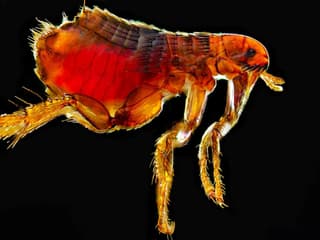 Cat fleaCtenocephalides felis1.5 to 3 mm, reddish-brown, wingless and flattened from side to side; the flea on South African dogs and cats.
-
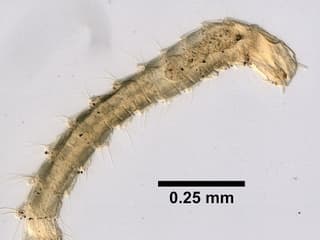 Flea larvaUp to about 5 mm, hairy, worm-like, no eyes or legs; lives in carpets and bedding, not on the pet.
-
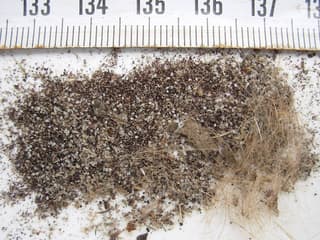 Flea dirtDark, pepper-like specks in the fur or bedding; they turn reddish-brown when dampened. The white specks beside them are eggs.
The photos are a guide, not a diagnosis. Species vary, and a technician on site will confirm which one you have.
Why treating the pet is not enough
Most of a flea population is eggs, larvae and pupae in the house; the usual estimate puts the adults on the pet at only about five percent. The adults stay on the animal, but the eggs are not sticky: they fall off wherever the pet rests, into carpets, bedding, couch cushions and the gaps between floorboards. The larvae feed there on the adults' dried droppings, then spin cocoons camouflaged with hair and carpet fibre. A fully formed flea can sit inside that cocoon for months, in cool conditions up to a year, until warmth, the pressure of footsteps or a vacuum cleaner, or the carbon dioxide of breathing tells it a host has arrived. That is why an empty house seems to explode with fleas when the new family walks in, and why fleas return weeks after the pet was treated.
Bites and health
- On people: a small red spot with a red halo, usually in groups below the knees; a wheal can appear within half an hour, but the itchy bumps most people notice come hours or even a day or two later; in allergic people one bite can itch for five days. Fleas prefer animals and bite people when the animal is not there. A quick check: walk the carpets in white socks pulled high and look.
- On pets: flea allergy dermatitis is a reaction to the flea's saliva and shows as itching and hair loss along the back, tail base and thighs in dogs, and as crusty spots and head and neck scratching in cats. Heavy infestations cause anaemia, often seen in kittens.
- Tapeworm: pets swallow fleas while grooming and pick up the flea tapeworm; people, most often children, can too, by swallowing an infected flea. The dried segments look like rice grains.
- Other germs: cat fleas carry the agent of cat scratch disease and can spread murine typhus. South African cat fleas have been found carrying Bartonella and Rickettsia bacteria.
When fleas peak in Gauteng
Fleas are on pets all year. In the one Highveld study, on kennelled dogs in Pretoria North in the 1970s, adult fleas were fewest from winter into spring and most numerous in early to midsummer and again from late summer into autumn. Warm, wet Highveld summers suit them. The cool, dry winter slows development outdoors; indoors, with a heater and a sleeping dog, it does not stop.
Signs
- Flea dirt: dark, pepper-like specks in the pet's fur or on its bedding that turn reddish-brown when dampened. Comb the animal over white paper and look.
- Obsessive scratching, especially along the back and at the tail base; bald patches.
- Bites around your ankles and lower legs, worst after a spell away from the house.
- Fleas landing on white socks when you walk the carpet.
What Ecopoise does
- Registered operators. Registered pest control operators with the Department of Agriculture; certified members of SAPCA and PCFSA.
- Registered products, used to the label. Ecopoise uses registered products and follows the label on every one of them.
- A spray treatment where the fleas are. The technicians spray the areas where the fleas are located, and may also do a treatment for the eggs.
- Guarantee: 3 months, in writing.
- Price. There are no set prices, because the price depends on the size of the area to be treated. Every job is quoted first.
Questions people ask
We moved into an empty house and now we are covered in bites. Why?
The previous occupants' pets left eggs that became pupae in the carpets. Fully formed fleas waited inside their cocoons, for up to a year in a cool house, and your footsteps, warmth and breath told them a host had arrived.
My dog has been treated. Why are there still fleas?
Because the adults on the dog are only a small part, by the usual estimate about five percent, of the fleas in the house. The eggs, larvae and pupae are in the carpets and bedding, and new fleas keep emerging from the cocoons for weeks. The home needs treating as well as the animal.
Can fleas live on people?
They prefer animals and bite people when the animal is not available. They do not live on people the way they live in a dog's coat, but they will keep biting your ankles as long as the house is breeding them.
Can I just send you a photo?
Yes. Send us a clear photo on WhatsApp. Nine times out of ten we can tell you what it is; when we cannot, we send it to an entomologist. WhatsApp it to 078 900 1536.
Sources and photo credits
Sources: University of California IPM Pest Notes 7419 (fleas, 2010); Rust, Insects 2017 (review of cat flea biology); Horak, Beaucournu and Braack, Onderstepoort Journal of Veterinary Research 2004; Horak 1982 (the Pretoria North kennel study); Van der Mescht, Matthee and Matthee 2021 and Matthee and others 2023 (South African flea DNA and bacteria); Cadiergues and others 2000 (jump distances); University of Kentucky ENTFACT-602 (2026); CDC, "About fleas" (2024) and DPDx on the flea tapeworm; Merck Veterinary Manual on flea allergy dermatitis (2026); Cornell Feline Health Center; NHS on insect bites (2023); Wikipedia, "Cat flea" and "Flea" (read 30 Oct 2026). Ecopoise keeps the full fact bank with every reference.
Identification photos, via Wikimedia Commons, cropped and resized: Cat flea: Andrei Savitsky (CC BY-SA 4.0); Flea larva: Daniel J. Drew, Yale Peabody Museum (CC0); Flea dirt: Auguste Le Roux (CC BY 3.0). The licence names link to the full licence text.


Seen the signs? Call or WhatsApp 078 900 1536
All of Gauteng.